


The Hidden Discipline Behind Great Design
My Journey Through Science, Semiotics, Brand Systems and Design
Written by Nina Kelly
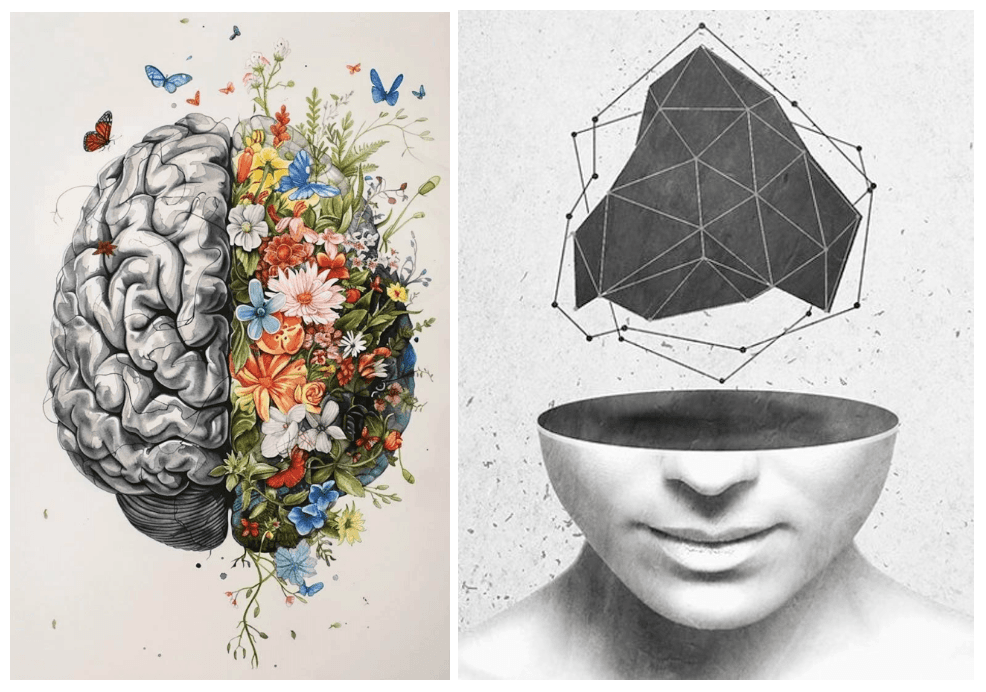
I used to think creativity and analytical thinking were completely different worlds.
One felt expressive, emotional and instinctive.The other felt structured, logical and methodical.
But looking back now, I realise my entire career has been spent discovering that the strongest creative thinking often comes from the deepest analytical thinking.
And perhaps more importantly, that meaningful design is rarely created through aesthetics alone.
It is created through understanding.
Before I ever entered the design industry, I was studying science.
I had always loved problem solving at school. Maths, biology and chemistry fascinated me. I loved systems, relationships and structure. Biology in particular felt like understanding an interconnected world — species, classifications, hierarchies, ecosystems, family trees. Everything had a relationship to something else. There was logic in how things connected.
I didn’t realise it at the time, but I was already learning systems thinking.
At the same time, I was obsessively creative.
I spent all my money on art books, pencils and pastels. I was constantly drawing, making and creating. Art felt instinctive to me in a completely different way. It gave me freedom, emotion and expression that science didn’t.
For a long time, those two sides of me felt disconnected.
Then one day, while helping a friend look at a design course, I walked into a design school and immediately thought:
“What am I doing?”
I changed courses shortly after and moved into communication design.
That was the real beginning.
At design school, I became obsessed with semiotics — the idea that visual communication systems were constantly speaking to people subconsciously, often without them even realising it.
I still remember writing an analysis on a sofa advertisement showing a daughter sitting on her father’s knee. The comfort, support and protection provided by the father emotionally mirrored the role of the sofa itself. The ad was not simply selling furniture. It was selling emotional reassurance through symbolism and human association.
That completely hooked me.
I became fascinated by the invisible layers of communication sitting underneath design. The idea that colour, shape, composition, imagery and form could communicate meaning far beyond what was explicitly being said.
It wasn’t just art anymore. It was psychology, behaviour, and human understanding.
My understanding and love of brands deepened the day I moved to London and joined Interbrand.
That was where I truly learnt the ins and outs: masterbrands, equities, distinctive assets, global systems, the long-term value of consistency and recognition. It was a true Masterclass.
My small claim to fame is redrawing the Dove bird icon for Unilever’s Dove brand — an asset that still exists today. I loved the idea that something you create could travel the world, hold memory, build meaning and become embedded in culture over time.
Again, this was never about random creativity, it was systems thinking.
After London, I moved to New York.
There, I became exposed to strategy teams more deeply. The “word people”, as we jokingly called them at the time. Strategists would define positioning, frameworks and narratives, and we as designers would bring them to life visually.
But the more I worked alongside strategy, the more I realised something important:
The best creative outcomes were never coming from decoration alone.
They were coming from understanding.
Understanding the people we were designing for, the tensions that they grappled with, and why they did the things they did. Same story for culture at-large; it’s full of contradictions and understanding those only ever strengthened the end result.
At the same time, I became obsessed with packaging design and structural form. Packaging felt like the perfect intersection between strategy, psychology, communication and physical experience. A bottle, a carton or a pack was not simply a container — it was a behavioural and emotional communication tool sitting directly in people’s hands.
Again, creativity became less about styling and more about meaning.
Years later, after moving back to Australia, meeting Chris and eventually founding BrandSociety, these ideas became formalised into our philosophy and methodology.
And interestingly, much of it unknowingly traced back to my early years studying biology and systems.
At BrandSociety, we believe the strongest opportunities sit at the intersection of Brand Insight and Society Insight.
Because brands do not exist in isolation.
They exist within people’s lives, behaviours, emotions, routines, aspirations and tensions.
That is where critical thinking becomes essential.
Not simply analysing what consumers say they want — but understanding the contradictions sitting underneath behaviour.
The tension between indulgence and wellbeing, convenience and quality, status and authenticity, and individuality and belonging.
This is where great design actually begins.
Not with decoration. Not with trend. Not with aesthetics in isolation. But with questioning.
Why do people behave this way?
What tension exists here?
What emotional need is unresolved?
What cultural shift is happening beneath the surface?
What relationships are forming or breaking down between brands and society?
Critical thinking allows us to deconstruct complexity and rebuild it into something meaningful.
That process has become fundamental to how we work.
We challenge briefs.
We rebuild frameworks.
We interrogate categories.
We look for patterns, contradictions and opportunity spaces.
We question what is assumed to be true.
Then creativity becomes the expression of that understanding.
Looking back now, I no longer see science, semiotics, strategy and creativity as separate disciplines.
To me, they were all teaching the same thing.
That meaningful creativity is not random, but rather the outcome of deeply understanding systems, relationships, behaviour and human meaning well enough to create something that genuinely connects.
Critical thinking is not separate from creativity.
It is what makes powerful creativity possible.